When architecture becomes a stage
Architecture is created to be inhabited, but sometimes its spaces acquire a different dimension and also become places from which stories can be told.
This is the case with CTZ2 House, the house designed by Pepe Giner Arquitectos overlooking Portitxol Bay in Jávea, chosen as one of the locations for Respira, the Netflix original series created by Carlos Montero.
In the fiction, CTZ2 House becomes the residence of the character played by Najwa Nimri, president of the Generalitat Valenciana. The house is thus integrated into the narrative of the series, becoming a cinematic space during filming while remaining recognisable as architecture.
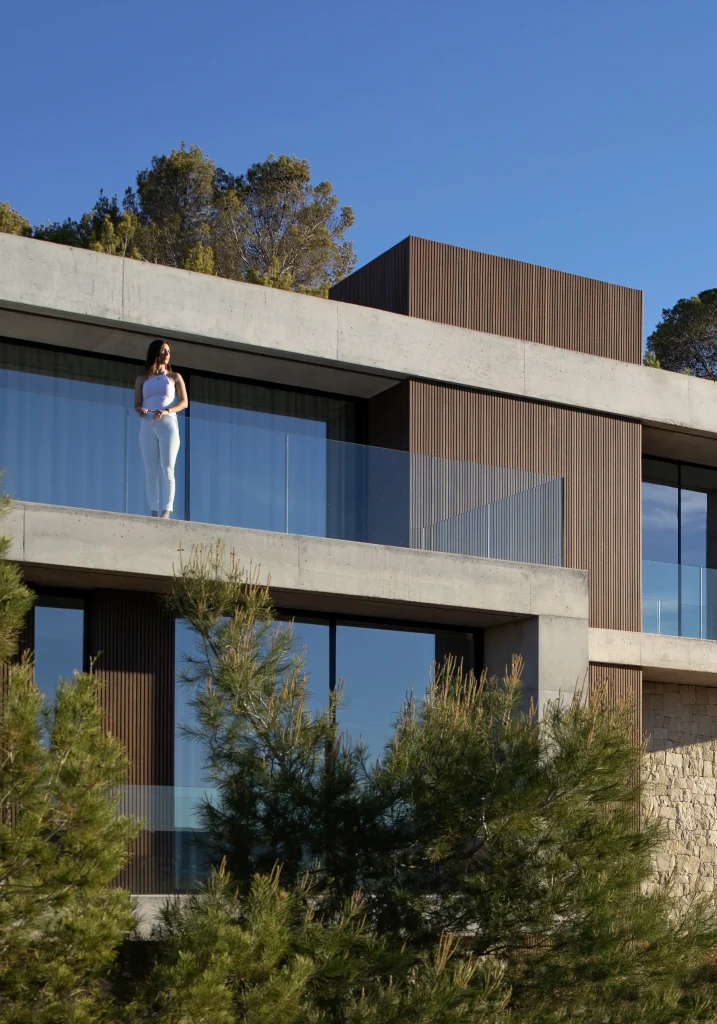
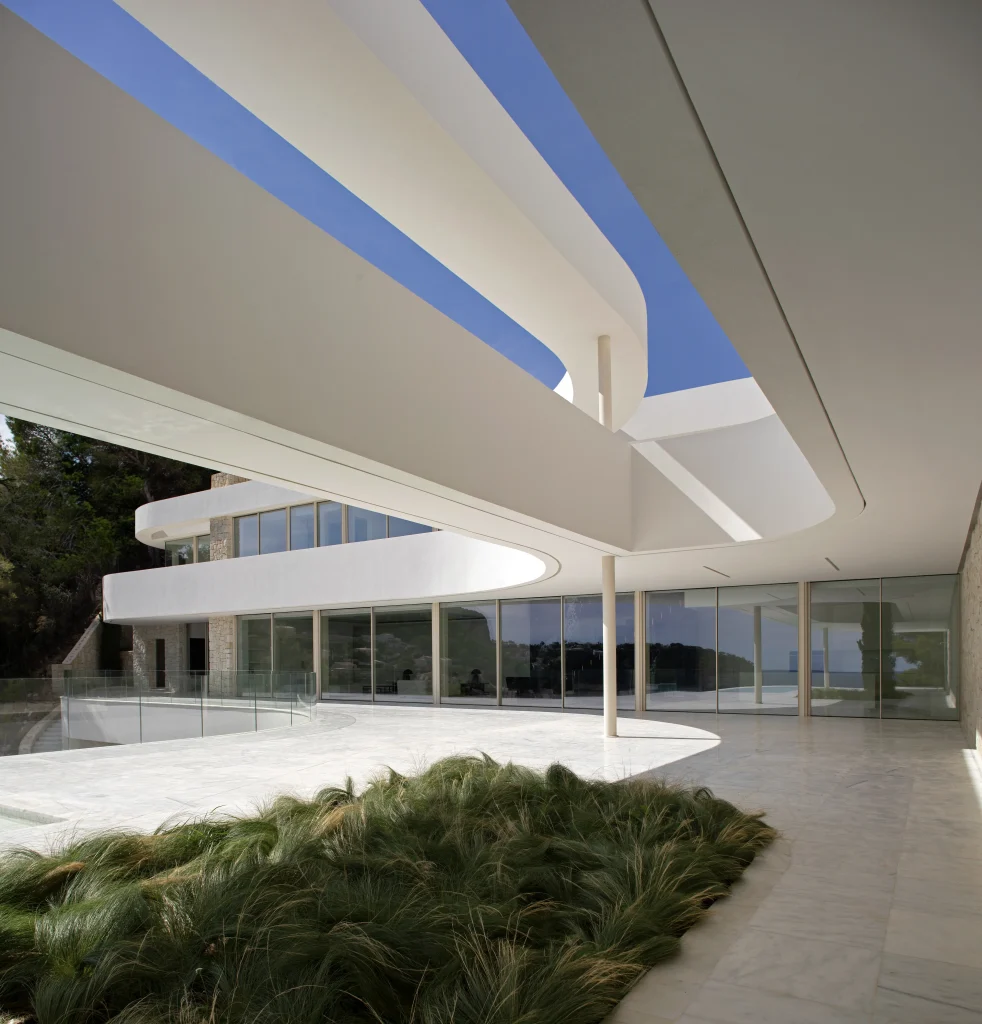
Its selection as a filming location is particularly interesting because of the very nature of the project. CTZ2 House is set on a steeply sloping plot oriented towards the Mediterranean. The house adapts to this topography through a succession of sinuous platforms that shift in relation to one another, creating terraces, routes and spaces open to the landscape.
The continuity between interior and exterior, the constant presence of the horizon, the Mediterranean light and the relationship between the horizontal platforms and the terrain create a spatial sequence with a strong visual character. These are precisely the qualities that also allow the house to work in front of a camera: the architecture does not act merely as a backdrop, but participates in constructing the atmosphere of the scenes.
The appearance of CTZ2 House in Respira also attracted the attention of publications specialising in architecture and design, which approached the project from different perspectives.


Designboom featured the house, focusing on its sinuous terraces and the way the platforms adapt to the steep slope of the terrain overlooking Portitxol Bay. The publication explicitly connected the architectural project with its appearance in the Netflix series, showing how interest in the house could be understood simultaneously through architecture and audiovisual culture.
MANERA also approached the house at the intersection of architecture, design, landscape and visual culture. Its article presents CTZ2 as the home of the character played by Najwa Nimri in Respira and explores the architectural solution developed in response to the steep slope, the opening towards the Mediterranean and the continuity between the house, its terraces and the garden.
ArchDaily, which had previously published CTZ2 House as an architectural project, subsequently covered its appearance in Respira, identifying the real house designed by Pepe Giner Arquitectos behind one of the series’ most recognisable locations.
The attention also reached general-interest media. Las Provincias published a feature on the Jávea house used during filming and included Pepe Giner’s perspective on the project, bringing the architecture behind the television setting closer to its readers.
The coexistence of all these perspectives is perhaps what makes the project most interesting. The same house can be viewed as an architectural project, as a response to a complex topography, as a particular way of inhabiting the Mediterranean and, at the same time, as the setting in which a fictional story unfolds.
The camera introduces a different way of looking at architecture. It frames routes, selects perspectives, uses light and temporarily transforms everyday spaces into stages. But what makes CTZ2 House recognisable on screen is precisely what defines the project beyond it: its relationship with the site.
Architecture remains the starting point. The landscape, the platforms that appear to extend towards the horizon, the swimming pool, the Mediterranean vegetation and the continuity between interior and exterior create an identity clear enough to function both as a home and as a setting.
The fact that CTZ2 House has found a new life through Respira and the publications surrounding the series allows the project to be seen from another perspective. Architecture ceases to be merely the space in which we live and becomes, for a time, the space in which we also imagine other lives.